
Science as Mindset
What STEM Actually Looks Like at WHPS
STEM is easy to put on a website. So are “innovation,” “engineering,” and “21st-century skills.” Living it is something else.
STEM is easy to put on a website. So are “innovation,” “engineering,” and “21st-century skills.” Living it is something else.
The real question is not whether STEM appears in admissions materials. It is whether students are actually thinking, designing, testing, and reasoning like scientists.
As we shared in this month’s accreditation article, schools can describe what they value. The more meaningful work is demonstrating how those values are embedded in curriculum, instruction, and measurable student growth.
At WHPS, science is not a standalone lab block or a collection of disconnected projects. It is a way of thinking woven across grade levels. While some subjects require tight sequencing, such as phonics or instrumental music, science pairs clear academic targets with structured intellectual freedom.
Students understand the objective. The intellectual work happens in how they design investigations, control variables, test hypotheses, and defend conclusions. That variation is not accidental. It is where the learning lives.
Across our elementary program, each unit begins with a meaningful driving question. Students observe closely, generate hypotheses, gather evidence, revise models, and reflect on what the data reveals.
Snapshots from Lower to Upper Elementary
-
Driving Questions:
What happens to old paper
What can we reuse?
How can we make something new from something old?
In Kindergarten, science begins with tangible materials and big ideas.
Students shredded recycled paper, soaked it, blended it into pulp, used molds to shape new sheets, pressed and dried their creations, and then wrote on their handmade paper to create notebooks.
This was not a craft.
It was material science.
Students observed changes in matter. Made predictions. Adjusted techniques. Reflected on outcomes.
Even at this age, they were given choice in how they shaped and refined their work. Agency grew alongside understanding.
Curiosity had structure.
-
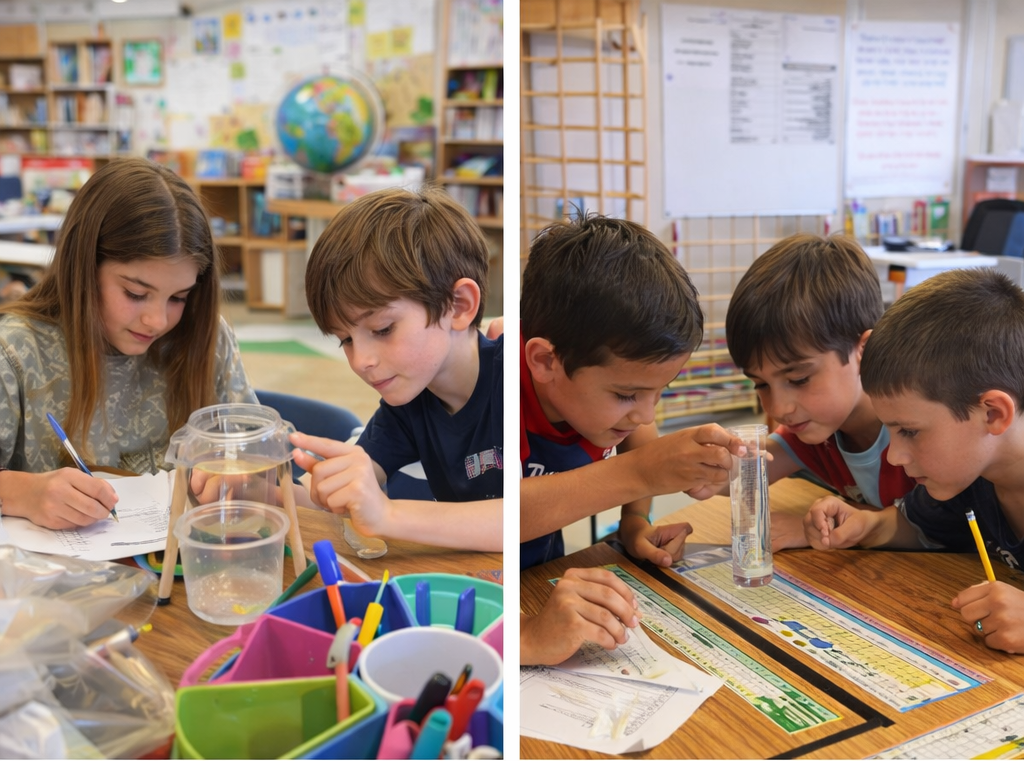
Driving Question: How can we design a tool to measure rainfall?
Students studied how scientists measure rainfall and why consistency matters. They examined real rain gauges and discussed what makes data reliable.
Then they moved into design.
They identified the need.
Researched existing models.
Sketched blueprints.
Built prototypes.
Tested and revised.Each student created a unique solution, carefully considering measurement markings, durability, and functionality.
The goal was shared.
The designs were not.
Students learned that science is not about guessing the teacher’s answer. It is about evidence, iteration, and thoughtful design.
Ownership deepened.
-
Driving Question: What would astronauts need to travel to and live on Mars, and how could we improve existing systems?
By Upper Elementary, science becomes interdisciplinary and expansive.
Students researched space travel constraints, astronaut needs, sustainability challenges, and current technologies. From there, they identified authentic problems to solve.
Some redesigned sweat-collection systems to purify water.
Others explored materials to improve space suit mobility.
Some reimagined systems for long-term sustainability.The question was shared.
The pathways were not.
Students debated evidence, collaborated on prototypes, tested ideas, and revised designs. They experienced firsthand that innovation rarely works on the first attempt.
Science became creative, analytical, and deeply human.
Why Structure and Flexibility Both Matter
In reading, mastery requires sequence. In science, mastery requires disciplined inquiry.
Students are given clear standards and high expectations. They are also given space to prototype, collaborate, iterate, and refine their reasoning.
That balance is especially powerful for advanced thinkers. When students must defend their ideas with evidence and revise based on results, engagement deepens and thinking becomes more precise.
They begin to see themselves not as students completing assignments, but as investigators shaping knowledge.
Across grade levels, students are not memorizing answers.
They are posing questions.
Designing controlled experiments.
Analyzing evidence.
Revising conclusions.
Inquiry. Design. Evidence. Reflection.
That is science in action. And that is what STEM looks like when it is embedded, intentional, and lived every day.