
Beyond the Brochure: What Accreditation Really Tests
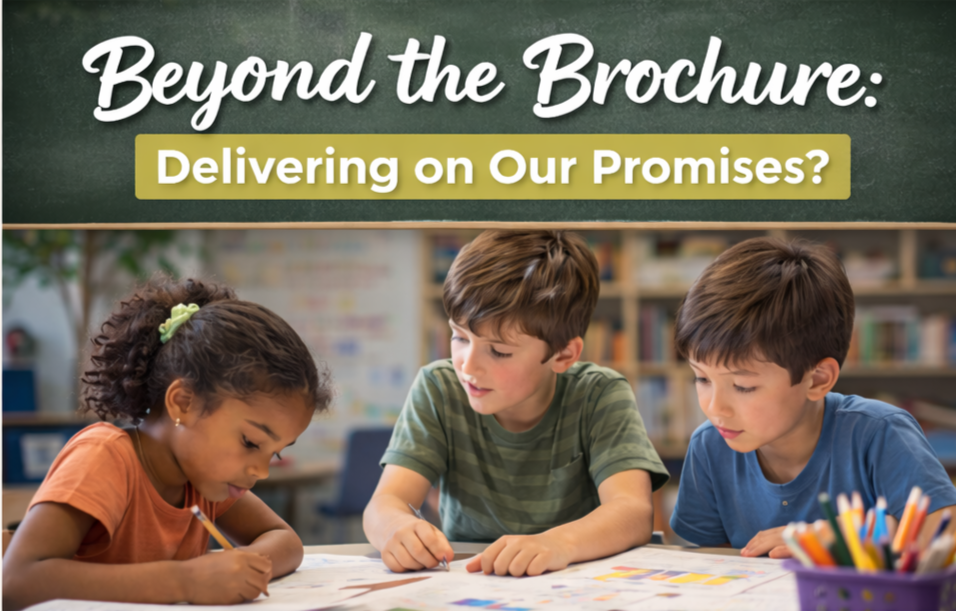
Every school has a polished website.
Beautiful language. Confident promises. The right vocabulary.
Whole child.
Critical thinking.
STEM.
Future-ready.
But strong words are easy.
Proof is harder.
The Questions That Actually Matter
Does your program actually work? How do you know?
Who is thriving — and who might be quietly slipping through?
Where are you leaning on tradition instead of current research?
Are students deeply engaged… or simply compliant?
How do students actually feel about learning?
What do teachers need to refine their craft?
What do families value — and what could evolve?
And perhaps most important: Are we willing to ask those questions out loud?
These are not marketing questions. They are leadership questions. Accreditation creates the structure to answer them honestly, publicly, and with evidence.
As a school leader, it is one of the professional cycles I look forward to most every six years. Yes, the self-study demands rigor and humility. But the real power is in peer review: experienced educators visiting classrooms, analyzing data, interviewing families, and asking the kind of sharp questions that reveal blind spots and spark progress.
I have experienced this on both sides — leading a school through accreditation and serving on visiting committees. In both roles, the work is not about compliance. It is about clarity. And growth.
From here, the question becomes: What does evidence actually look like?
Below are a few examples of how that shows up at WHPS.
-
Strong readers are built early.
The foundation laid in Transitional Kindergarten through first grade determines whether students can access complex language, analyze demanding texts, and think deeply across subjects for years to come.
That foundation matters just as much for the many students at WHPS who enter TK or Kindergarten already reading fluently.
During our previous accreditation cycle, we identified an important pattern: some advanced early readers later showed gaps in foundational decoding when academic language became more complex in Upper Elementary. Early fluency and comprehension had masked weaknesses in the underlying phonics architecture, which only surfaced when vocabulary and word analysis demands increased.
We chose to respond strategically.
Not by slowing high achievers down.
But by strengthening the foundation while keeping them on an accelerated trajectory.One key part of that plan has been investing in faculty expertise. Our Lower Elementary Lead, Melissa Pero, is engaged in advanced postgraduate study in the science of reading and UFLI implementation, translating current cognitive research directly into classroom practice.
UFLI’s structured sequence and frequent assessment, including pseudowords, allow us to see whether students are applying transferable decoding skills or relying on memorization. Gaps are identified early, before they become comprehension breakdowns years later.
For gifted and high-achieving readers, this means acceleration with precision.
For emerging readers, it means systematic instruction that closes gaps efficiently.This is what showing the receipts looks like:
Research-aligned instruction
Deep faculty training
Early identification of hidden gaps
Acceleration balanced with durability
The goal is not simply early reading.
It is long-term resilience, fluency, and confidence with complex academic language.
Accreditation validates that this alignment between research, staffing, curriculum, and measurable growth is coherent and working across the full spectrum of learners.
-
We made a similar intentional shift in mathematics.
During our last accreditation cycle, we adopted Singapore Math consistently across Transitional Kindergarten through fifth grade and invested heavily in professional development to ensure strong implementation. The materials matter. But research consistently shows that teacher expertise and instructional coherence matter at least as much as the curriculum itself.
Singapore Math is grounded in decades of international research and is widely recognized for promoting deep conceptual understanding and critical thinking beyond traditional procedural programs.
It can look slower in the early years because it is building something durable. Even in kindergarten, students are mapping number relationships and patterns that later support algebraic reasoning.
That foundation compounds.
Last year’s graduating class was the first cohort to experience Singapore Math consistently from TK forward. The long-term investment is now visible in measurable outcomes.
More than half of students in grades 3–5 scored at or above the 77th percentile in mathematics compared to independent schools nationwide.
Many scored at or above the 89th percentile, placing them ahead of nearly 9 out of 10 peers.
A significant cross-section scored at or above the 96th percentile, qualifying for the Johns Hopkins Center for Talented Youth.
These results are especially meaningful given the large proportion of gifted and high-achieving learners in our community. Our goal is not simply to accelerate them faster. It is to ensure that acceleration rests on durable conceptual understanding.
This is not about test preparation.
It is about students who understand mathematics.
Who reason flexibly.
Who can transfer knowledge to unfamiliar problems.
Who approach complexity with confidence.When curriculum, research, and professional development align across grade levels, growth becomes both measurable and sustainable.
Accreditation validates that this system is coherent, research-based, and working across the full spectrum of learners—from those building foundational number sense to those operating at the top of the curve.
-
Academic growth does not happen in isolation.
Executive functioning and social-emotional skills are among the strongest predictors of long-term success. They are also the skills most likely to limit progress when academic demands increase and independence expands in Upper Elementary.
Following our last accreditation cycle, we made a strategic decision to bring greater clarity, precision, and developmental alignment to this area.
Under the leadership of our Dean of Students, Cynthia Baroudi, we built a research-aligned progression that makes social-emotional growth observable and specific at each grade level.
Rather than broad categories like “behavior” or “work habits,” we defined clear developmental benchmarks so students and families understand what growth looks like and how it unfolds over time.
But the goal is not evaluation. It is accurate self-reflection.
During student-led conferences, students identify strengths, reflect honestly on areas for growth, and set one high-impact goal with concrete indicators of success. They are learning to:
Initiate work independently
Manage time effectively
Regulate emotions under challenge
Seek help appropriately
Evaluate their own performance with honesty
These are the same competencies that leadership programs inside Fortune 500 companies invest heavily in developing.
At WHPS, we begin building them in elementary school.
This durable growth mindset — the ability to reflect, adjust, and improve — is one of the clearest hallmarks of the WHPS graduate profile. It is a major reason our students continue to excel long after they leave our campus.
Accreditation validates that this system is not incidental or personality-driven. It is coherent, developmentally aligned, and consistently implemented across classrooms.
-
During our most recent accreditation visit, the committee awarded WHPS the highest term of six years and described the program as exemplary.
They noted:
A strong, supportive community centered on student uniqueness
A safe and nurturing environment
Innovative instruction and strong collegial trust
Differentiation driven by formative assessment
Leadership development through goal setting and Student-Led Conferences
Strong preparation for middle school
External validation matters. Not because it flatters us. Because it confirms coherence.
🎯 Why This Matters
Families choose WHPS intentionally. Not for slogans. Not for trends. But for long-term growth.
Accreditation is where that intention is tested.
It is where research supports practice.
Where staffing aligns with priorities.
Where growth is measured and refined.
Where promises become evidence.
Beyond the brochure, what matters is alignment: Alignment between what we say. What we teach. What we measure. And what students are actually able to do.
This is why I look forward to each renewal cycle.
It mirrors the process we teach our students:
Reflect honestly.
Be specific.
Set meaningful goals.
Do the work.
Grow.
That mindset is not something we turn on for accreditation. It is how we strive to lead.