

From Make-Believe to Real Skills
Why Imagination Matters in Early Childhood
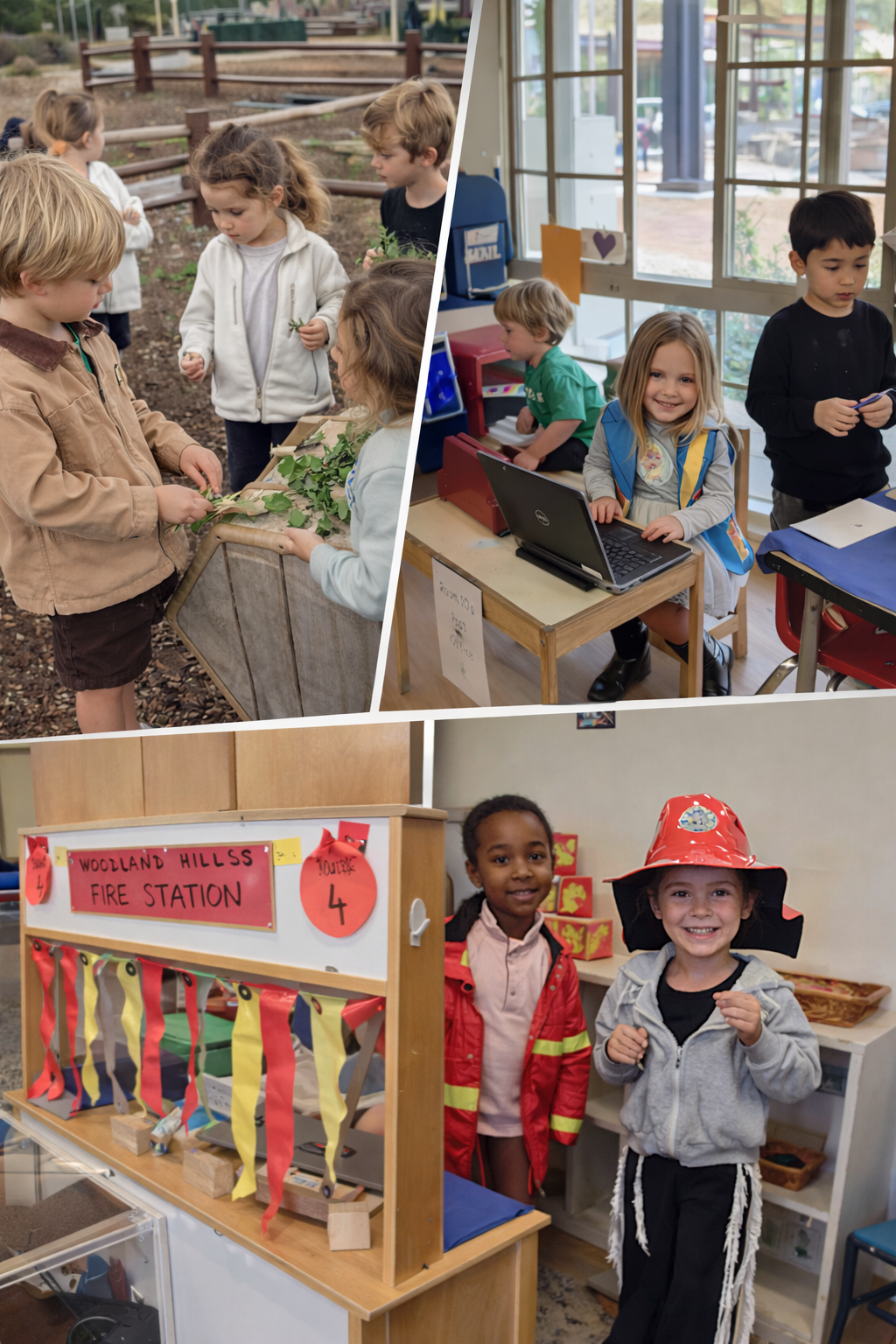
Walk into a preschool classroom and you might see a restaurant opening, a veterinary clinic in full swing, or astronauts preparing for liftoff.
To an outside observer, it may look like “just play.”
But inside those moments, something far more important is happening.
At WHPS, imagination is not a break from learning. It is the learning.
Through our Emergent Curriculum and play-based approach, children explore ideas, solve problems, build language, and practice essential life skills in ways that feel joyful and deeply meaningful. The work may look light. The cognitive load is anything but.
Every day, teachers intentionally design environments that invite imagination during dramatic play, process art, outdoor exploration, and role-playing during circle time. These experiences are not filler. They are foundational.
Here’s what that really builds.
-
(Kitchens, doctors’ offices, families, stores)
When children take on roles, they are not simply pretending. They are negotiating. Planning. Collaborating.
They practice complex language as they explain ideas and stay in character. They navigate turn-taking and conflict resolution. They learn to consider another person’s perspective.
Dramatic play is often where children first learn how to disagree respectfully.
They negotiate roles. Advocate for their ideas. Compromise when plans change. All within a safe, supervised environment where teachers provide scaffolding, model language, and guide problem-solving.
This matters more than many adults realize.
In these moments, children are learning how to manage differing opinions and competing desires long before the stakes become higher and adult support becomes less direct. They are building the early foundations of communication, diplomacy, and emotional regulation.
Dramatic play is not a break from learning.
It is where leadership, empathy, and executive functioning quietly begin.
-
(Open-ended art experiences)
In process art, there is no model to copy and no “right way” to finish.
Children focus on exploration instead of performance. They test ideas. Adjust. Try again.
That flexibility builds creative thinking and problem-solving skills that highly structured, product-driven art cannot replicate.
When art experiences are overly guided or designed so that every child produces the same finished product, the focus shifts from thinking to compliance. Children begin asking, “Is this right?” instead of “What if I try this?”
Over time, that shift matters.
Open-ended process art invites children to take intellectual risks. They make choices. Revise plans. Persist when materials don’t behave as expected. They discover that there are multiple approaches to a challenge and that their ideas have value.
That mindset builds confidence, creativity, and cognitive flexibility.
The goal is not a matching display on the wall.
The goal is a developing mind.
-
(Sand, bikes, open materials)
Outdoor play is not just physical release. It is applied learning.
When children figure out how to move sand efficiently, balance on a bike, or invent a new game with friends, they are engaging in early engineering, risk assessment, and persistence.
They assess safety. They recalibrate. They try again.
These are the early roots of resilience.
-
(Circle time and guided scenarios)
When children act out stories or real-life situations, they strengthen listening skills, expand vocabulary, and deepen comprehension.
But something even more powerful is happening.
They practice regulating their bodies and voices. They wait. They respond. They stay engaged in a shared narrative.
This kind of guided imaginative work builds the self-regulation skills that research consistently links to long-term academic success.
What the Research Actually Shows
Imaginative play is not a trend. It is one of the most studied and supported aspects of early childhood education.
Across decades of research, pretend and symbolic play have been linked to:
• Stronger self-regulation
• Increased language development
• Early literacy and math growth
• More advanced problem-solving
• Greater cognitive flexibility
• Stronger coping skills over time
Children who regularly engage in rich imaginative play do not just enjoy school more. They build neural pathways that support focus, emotional management, and persistence.
The benefits do not disappear when playtime ends.
They compound.
Research also shows that play-based learning often outperforms passive tasks like worksheets or rote activities. When children imagine, explore, and create meaning, their brains are more deeply engaged.
Simply put: play builds the brain.
And it builds it in lasting ways.
Why Balance Matters: Child-Led and Teacher-Guided Play
Not all play serves the same purpose.
When children lead their own small-group play, they strengthen autonomy and decision-making. They negotiate roles. Solve disagreements. Carry out ideas without constant adult direction.
This independence builds confidence and self-awareness.
At the same time, teacher-guided imaginative experiences are powerful when introducing new or complex ideas. When teachers step into the play through storytelling, dramatic scenarios, or role-play, they extend vocabulary, deepen thinking, and introduce early STEM concepts in ways that feel memorable and meaningful.
The key is calibration.
Effective classrooms provide rich materials, flexible structure, open-ended questions, and emotional safety. Teachers are present and observant, but not overpowering. They know when to step in and when to step back.
That balance is not accidental.
It is trained.
It is intentional.
It is part of what distinguishes a thoughtfully designed early childhood program from a room simply filled with toys.
Imagination Is Powerful Work
When children pretend to be veterinarians, chefs, astronauts, or parents, they are not passing time.
They are practicing communication.
Experimenting with problem-solving.
Learning to collaborate.
Managing emotions.
Adapting when plans change.
They revise ideas. Negotiate storylines. Persist when their “mission” does not unfold as expected.
These playful moments lay the foundation for academic learning.
More importantly, they lay the foundation for confident, capable learners.
When we give children time and space to imagine, we are not “just playing.”
We are helping them build the skills that prepare them for kindergarten, for elementary school, and for the increasingly complex world beyond.
We are helping them discover not only who they can pretend to be — but who they are becoming.