
The brochure stops talking. Now the work gets to speak for itself.
Last month I wrote about why strong schools invite scrutiny rather than avoid it. This month, we open the doors.
From April 20–22, a visiting committee from the Western Association of Schools and Colleges will spend three days inside WHPS. Not in a conference room reviewing binders. In classrooms, watching children learn on an ordinary April afternoon.
We Need You in the Room
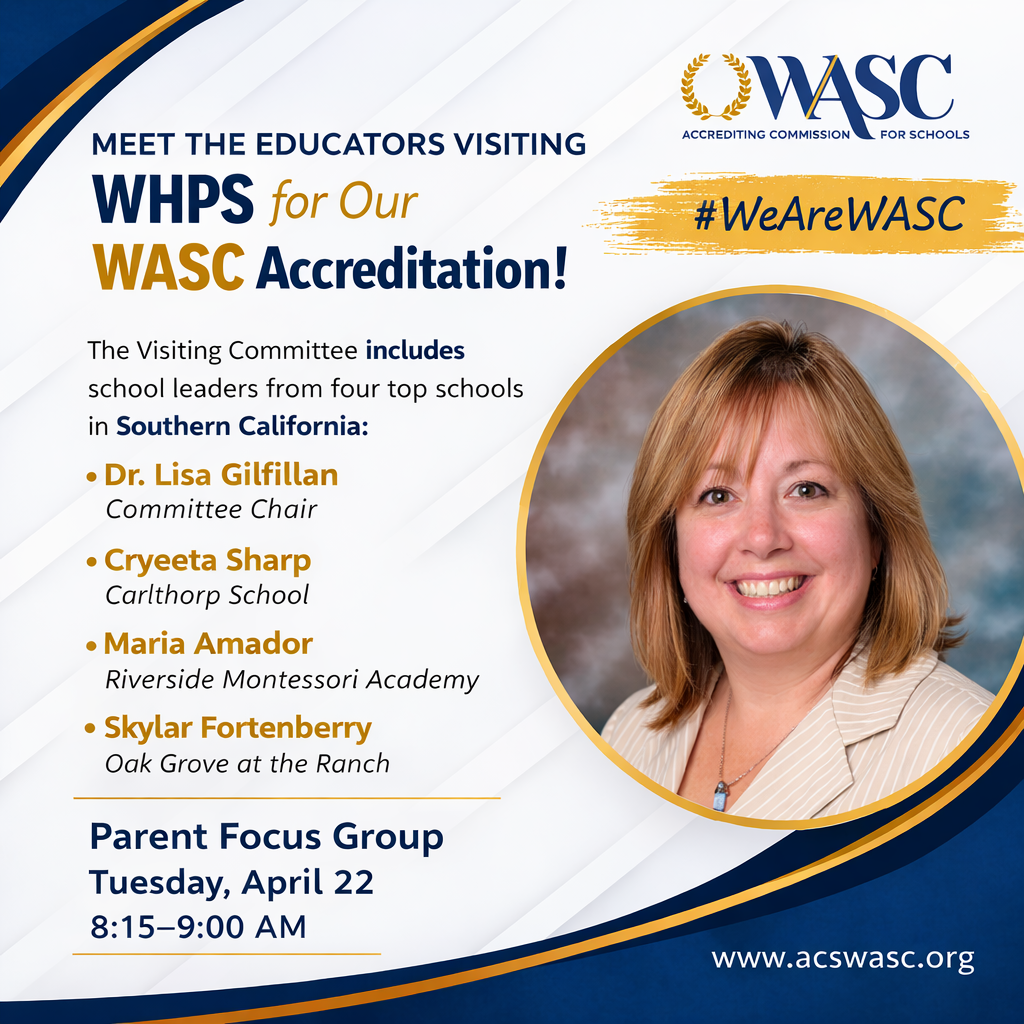
Parent Focus Group
Tuesday, April 22 · 8:15–9 AM
This is one of the most powerful conversations of the entire visit. The committee wants to hear from families directly. No filter, no administrator in the middle.
What stands out. What made you choose WHPS. What your child's growth has actually looked like. What you hope comes next.
No prep. No right answers. Just your honest experience.
We need 30 or more families in that room. If you've ever had a moment, driving home from school, watching your kid at a performance, reading something they wrote, where you thought this is exactly why we chose WHPS...
That story belongs in this room. Show up.
What They'll Actually See
-
Visiting educators from other independent schools spend three days moving through both campuses observing real lessons, reviewing six years of student work and data, and sitting down with teachers, administrators, students, and parents. They're not checking boxes. They're testing alignment between what a school claims to stand for and what's actually happening when the bell rings.
Kindergartners publishing persuasive writing, making their case for changes they believe will make school even better, preparing to present to a real audience, because that's how we've taught them to think about their writing from day one. Fifth graders working on algebra, simply because they demonstrated the readiness to move beyond elementary math. Preschoolers in the Barnyard recording data, making predictions, and handling a ball python with the kind of calm confidence that only comes from a thousand small moments of being trusted with real responsibility.
That's an ordinary day at WHPS. We can't wait to show it off.
-
We spent six months on our self-study. Enrollment. Student achievement. Literacy. Math. SEL. Teacher development. How clearly we communicate with families. All of it.
We named what's working. And there's a lot.
ERB scores at the very top among independent schools nationally. A co-teaching model keeping ratios around 1:12. A literacy program grounded in the Science of Reading with results that compound year after year. A living Barnyard with 75+ animals anchoring a TK–5 life science curriculum you cannot find anywhere else in the Valley.
But here's where it gets real.
We also named the areas where constructive feedback from families, honest input from our faculty, and our own hard look at the data say we can do better. Making math differentiation pathways more transparent so you always understand how your child's placement is decided. Building smarter systems to track growth across multiple years, not just snapshotting a single school year and moving on. Communicating more clearly about what our learning progressions mean at each stage of your child's development so nothing ever feels like a mystery.
Those aren't failures. They're exactly what a school that's paying attention looks like.
If a school can't name its growth areas with that kind of honesty, if the data always confirms the narrative and the brochure never has to answer for itself...
I have two words for you.
Run.
The schools worth trusting will look you in the eye and say: here's what we're still building, here's the data, and here's our plan. That's not vulnerability. That's integrity. It's what you deserve from the people educating your child.
-
Five priorities for the next six years, named publicly and monitored seriously:
Longitudinal data that actually follows your child. A clear view of growth across literacy, math, writing, SEL, and executive function across a child's entire time at WHPS, not just year-to-year snapshots.
Math differentiation you can see and understand. Transparent pathways to enrichment and acceleration, clear readiness criteria, no mystery about how decisions get made.
Professional development that proves its worth. Not just whether teachers attend training, but whether it changes what happens in classrooms and what students are able to do. We want receipts.
Communication that earns its keep. Family trust at WHPS is genuinely strong. Clarity about how our systems work will make it stronger.
Student voice that goes deeper. Building on Student-Led Conferences and leadership notebooks to make reflection and self-advocacy more consistent and more powerful across every grade level.
Why the Best Data Point Is a Kid
The committee will also meet with students. If you want the most honest read on a school, start there. Every time. Children don't perform for visiting committees. They just show you exactly how they've been taught to think. Whether they advocate for themselves. Whether they take ownership or wait to be told what to do. Whether they can sit down with a stranger, walk them through their work, and explain why every decision was intentional. At WHPS that shows up everywhere. In Student-Led Conferences where a 3rd grader explains every revision to their writing and why. In leadership notebooks where students have tracked their own goals all year in their own words. In a kindergartner at the Morning Assembly mic with no script, no nerves, and nothing to prove except that their voice has always mattered here. The committee is going to see all of it. It will speak for itself.
What Opening Your Doors Actually Means
Not every school does this. Accreditation asks schools to invite experienced outside educators to examine everything, classrooms, data, decisions, culture, with no filter and full transparency. It is one of the most meaningful signals a school can send: We believe in this work enough to let others test it.
The same standard we hold our students to every day applies to us.
Reflect honestly.
Name what's hard. Invite the scrutiny.
Do the work.
Grow stronger.