What Real Writing Growth Actually Looks Like in Elementary School
At first glance, elementary writing can look deceptively simple.
A…drawing.
A…short story.
A…few sentences neatly written on a page.
But what’s really happening is far more complex. Children are learning how to organize ideas, make decisions as authors, revise their thinking, and communicate clearly to someone else. Those aren’t “cute” skills. They’re foundational ones that shape how students think across subjects.
At WHPS, writing isn’t something students do once they’re ready. It’s something they grow into—intentionally and over time.
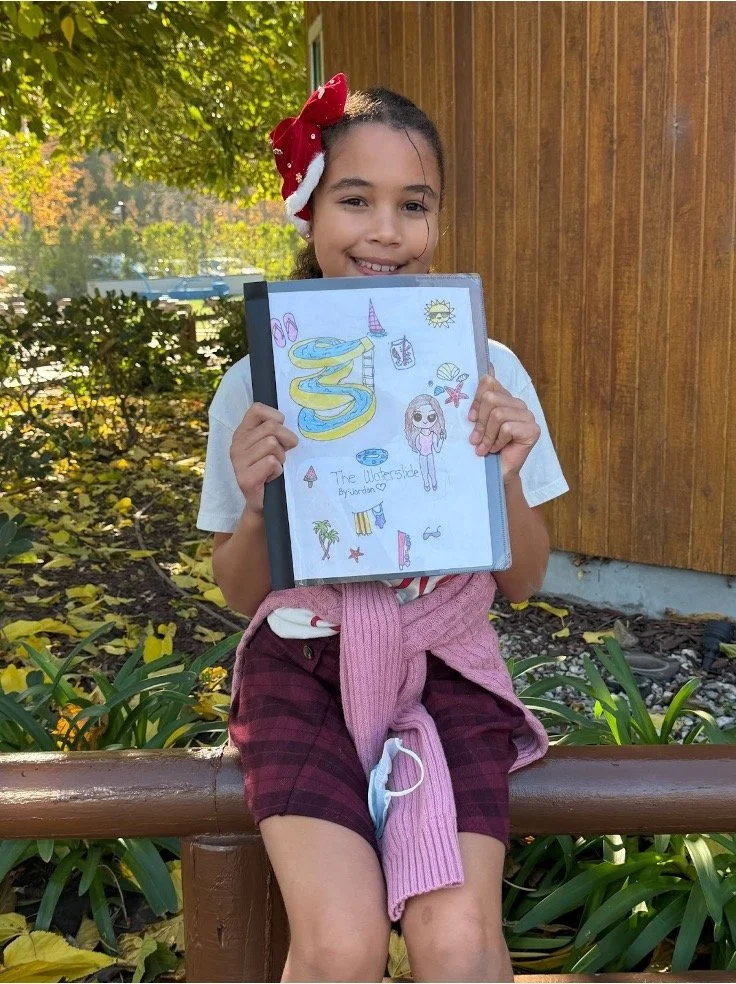
✨ Featured 4th-Grade Narrative: “The Waterslide” by Jordan
Jordan, a fourth grader, offers a powerful example of what this kind of growth looks like in practice.
In her narrative The Waterslide, Jordan recounts the emotional journey of confronting a fear on a Disney Cruise. After carefully observing the sparkling water and glowing blue lights beneath the slide, she climbs the steps with anticipation—only to turn back at the last moment, feeling embarrassed and disappointed. As she watches other children splash into the pool, she captures a layered mix of sadness, determination, and courage.
On her second attempt, Jordan places herself at the front of the line. She describes nervously tugging at her swimsuit sleeve and imagining everything that could go wrong. Once the slide begins, fear gives way to exhilaration. Twists, turns, and sprays of cold water create a vivid, unforgettable moment. By the end of the piece, Jordan reflects on a powerful realization: sometimes you just have to be brave and go for it.
Jordan’s writing demonstrates vivid imagery, rich sensory detail, authentic inner thinking, and a confident voice. At times, she shows rather than tells how she is feeling, allowing readers to experience the moment alongside her. Structurally, the piece shows clear sequencing and a purposeful arc, with an ending that reflects on meaning rather than simply stopping. These are skills often expected to develop later in elementary school, yet Jordan is already applying them thoughtfully.
At the same time, Jordan continues to work on refining conventions and editing habits, with clearly articulated goals that support polish and clarity. This balance—advanced strength in some areas alongside active growth in others—is exactly what we aim for.
One of the most powerful features of our writing program is that there is always a clear next step. Even when students exceed grade-level expectations in areas like structure or craft, our learning progressions guide teachers and students toward what deeper sophistication looks like next.
Jordan knows what she does well as a writer. She also knows what she’s working toward. That clarity allows her to keep growing—without ceilings or labels.
(The full student piece is linked so families can enjoy Jordan’s work in its entirety.)
-
That intentionality starts early.
In Kindergarten, students begin by learning how to get their thoughts onto the page—through drawing, labeling, and early sentences that help them see themselves as writers. Alongside these foundational mechanics, teachers are also supporting something more personal: the early development of each child’s unique voice.
As the year progresses, students learn to tell clear stories with a beginning, middle, and end. They experiment with language, detail, and expression, discovering that writing isn’t just about getting ideas down—it’s about how they choose to tell them.
By the end of the year, many Kindergarteners are writing persuasive pieces—imagining something they would like to change or improve and making the case for it in writing. Even at this early stage, students are learning that writing is about ideas, structure, and purpose—and that their perspective matters.
-
As students move up through the grades, expectations sharpen.
Our Writing Workshop is carefully articulated across elementary school—not just by genre, but by skill. Students develop progressively in areas such as structure, craft, elaboration, word choice, sentence fluency, and conventions.
The work doesn’t simply get longer.
It gets more thoughtful, more precise, and more demanding.Students learn how to plan with intention, revise with purpose, and make decisions based on audience and meaning—not just completion. This kind of writing work builds more than academic skill—it develops the habits of thinking, adaptability, and judgment that matter in a world where the future is anything but predictable.
Families can see how these skills build over time through our parent-friendly writing learning progressions, which outline how writers develop across structure, craft, elaboration, and conventions from TK through middle school.
-
Jordan H., a fourth grader, is a strong example of how this progression looks in practice.
In her narrative “The Waterslide,” Jordan recounts the emotional journey of confronting a fear while on a Disney Cruise. After carefully observing the sparkling water and glowing blue lights beneath the slide, she climbs the steps with anticipation—only to turn back at the last moment, feeling embarrassed and disappointed. As she watches other children splash into the pool, Jordan captures a layered mix of sadness, determination, and courage.
On her second attempt, Jordan places herself at the front of the line. She describes nervously tugging at her swimsuit sleeve and imagining everything that could go wrong. When the slide finally begins, the emotional shift is clear. Fear gives way to exhilaration as twists, turns, and cold sprays of water create a vivid, memorable experience. By the end of the piece, Jordan reflects on a powerful realization: sometimes you just have to be brave and go for it.
Jordan’s writing demonstrates vivid imagery, sensory detail, authentic inner thinking, and a strong, confident voice. Structurally, the piece shows clear sequencing and a purposeful arc, with an ending that reflects on meaning rather than simply stopping. These are skills typically expected to develop later in elementary school, yet Jordan is already applying them thoughtfully.
At the same time, Jordan continues to work on refining conventions and editing habits, with specific goals that support clarity and polish. This combination—advanced strength in some areas and active growth in others—is exactly what we expect to see in a well-articulated writing program.
One of the strengths of our Writing Workshop is that it always helps teachers and students identify what comes next. Even when a student is working beyond grade-level expectations in areas like structure or craft, the learning progression makes the next level of sophistication visible and attainable.
Jordan knows what she does well as a writer. She also knows what she’s working toward. That clarity allows her to keep growing without artificial ceilings.
The original published piece is linked so families can read Jordan’s full work and see this progression firsthand.
-
At WHPS, writing isn’t something students produce simply to earn a grade.
Publishing celebrations are a meaningful part of our program and our mission. When students share their work—through classroom celebrations, readings, displays, and presentations—they experience what it means to write for a real audience.
That audience changes how students approach their work.
They revise more thoughtfully.
They care more deeply about clarity, voice, and impact.This emphasis on authentic audience extends beyond writing. As part of our broader learning progression, students also develop public speaking skills—learning how to share ideas clearly, confidently, and appropriately as they grow.
These experiences connect directly to the writing skills students are developing over time, reinforcing the idea that learning is cumulative, purposeful, and meant to be shared.
Why This Matters Beyond Elementary School
Strong writing doesn’t happen by accident.
It’s built through explicit teaching, meaningful feedback, authentic audience, and increasing ownership over time. When students understand themselves as writers—and as communicators—they carry that confidence into every subject and every setting.
Writing is thinking made visible.
And when children learn to think clearly, express ideas with purpose, and revise with intention, the impact lasts far beyond elementary school.