
What Will Your Child Discover They’re Good At Next?
What happens when a child has an idea and no one tells them exactly how to make it work?
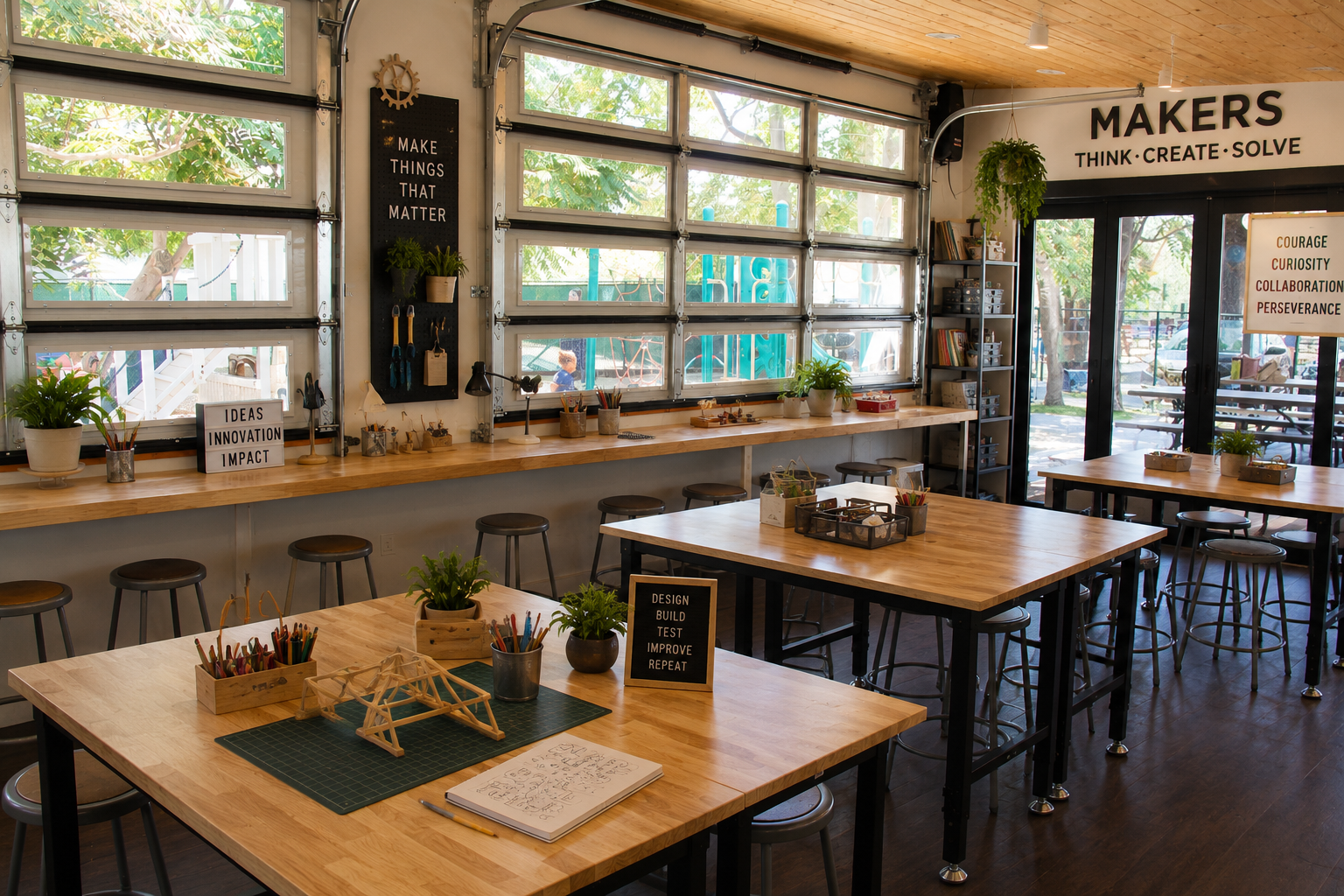
That’s one of the things I’m most excited to watch as we open our new Maker Studio and bring Maker education into the heart of our Upper Elementary curriculum. The studio gives students new tools, technologies, materials, and room to build, experiment, and create. But the room isn’t really the point.
Turning an idea into something real requires choices, collaboration, precision, persistence, and figuring out what to do when the first plan doesn’t work. Somewhere in that process, a child may discover an eye for design, a fascination with engineering, an unusual ability to troubleshoot, or simply the confidence that comes from realizing, I had an idea, I stayed with it, and I made it real.
You Can’t Discover a Strength You’ve Never Had the Chance to Use
A child can’t know they enjoy engineering if they’ve never engineered something. They may not know they have an eye for design until they’re asked to design, or that they love troubleshooting until something stubbornly refuses to work. That’s why breadth of experience matters: different experiences reveal different parts of a child.
Not every child will love every part of Maker, and that’s valuable too. Learning what interests you, what doesn’t, what comes naturally, what requires persistence, and what you want to explore further is part of understanding yourself.
The First Idea Isn’t Supposed to Work Every Time
Much of school is necessarily structured. Maker creates room for something different. There may be several workable solutions, and children have to make choices without knowing whether they’re the right ones. A structure fails. A measurement is off. A material behaves differently than expected. Someone else has a better idea.
Those moments are where some of the most interesting learning happens. Instead of immediately fixing the problem, a teacher can ask a question, offer just enough guidance, and give children room to wrestle with it themselves. They test, revise, listen, rethink, and try again.
The tools will change. The technologies will change. The ability to stay with an idea when making it real gets complicated can travel with them.
Inside Maker at WHPS
Why You’ll See More Than the Finished Product
Come See What We’ve Built. Then Watch What They Build.
Elementary families can visit the new Maker Studio during Back-to-School Night on Thursday, September 3, from 4:00–4:30 p.m. Come explore the space, meet Brie and Agustin, and see the environment students will begin making their own this year.
We’ve spent a long time thinking about the program, the space, and what we hope children will experience there. Now comes the more interesting part: seeing what the children do with it.
Melanie Henson
Principal