
Finding Your Roots Project
Upper Elementary Humanities
Immigration sits at the intersection of American history, current events, and the deeply personal stories of families. Finding Your Roots invites our 4th and 5th Grade students to investigate all three.
Beginning the Inquiry
Connecting History With the World Around Us
Immigration is part of the history students study, but it is also something they encounter in the news and in conversations around them. We begin by asking what children already know, what they have heard, and what they genuinely wonder.
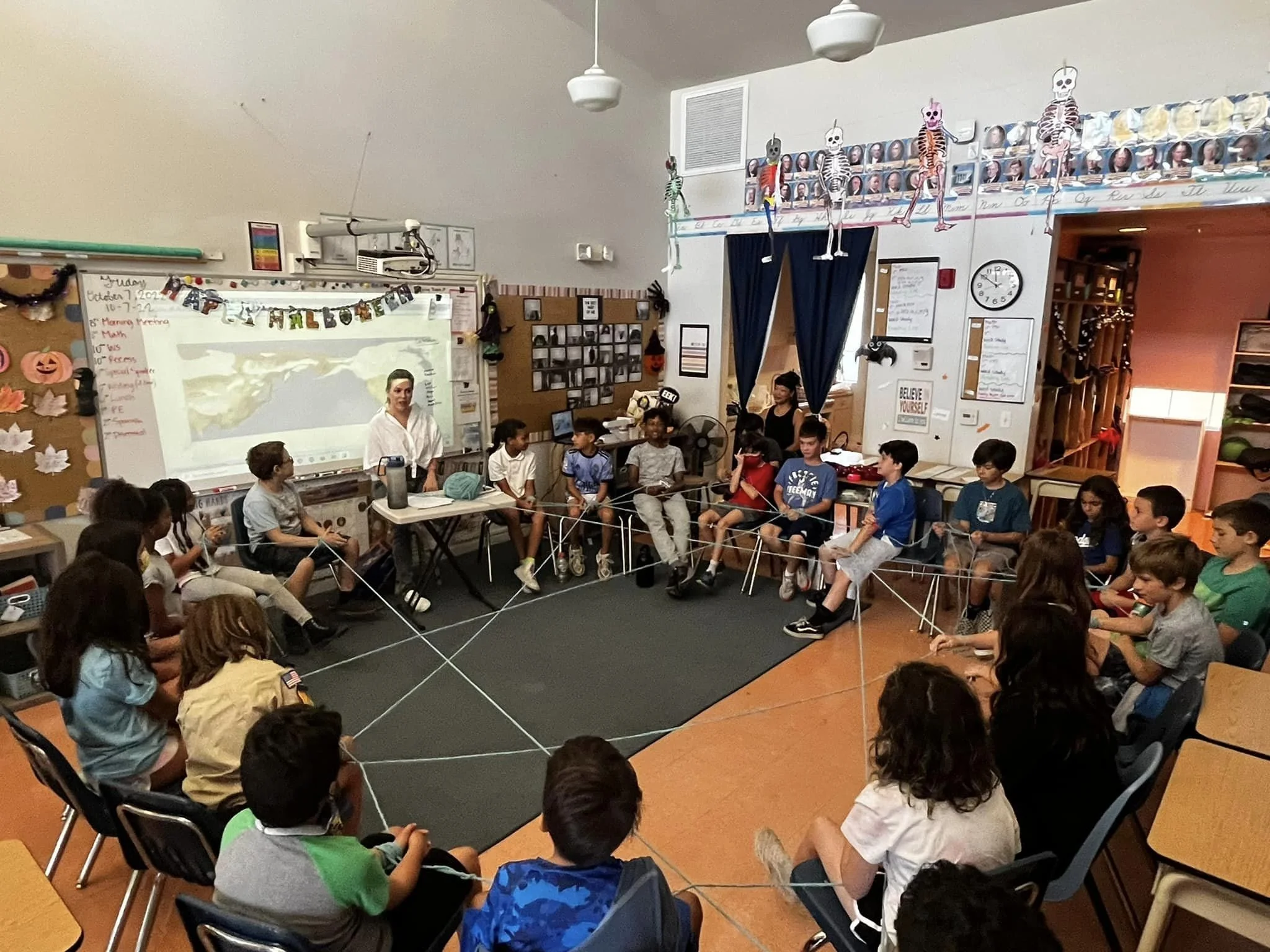
An expert guest speaker from our school community has also joined students for a sharing circle exploring contemporary immigration, DACA, and border policy. As students listened and asked questions, they created a physical web connecting ideas around the circle — a simple way to make visible the relationships among policy, history, and individual experience.
Some of the Questions We Investigated
Why do people immigrate to America?
What might cause someone to leave a home or country behind?
What opportunities might draw a family somewhere new?
Who has been welcomed into America, and who has been excluded?
How have immigration laws and attitudes changed over time?
What challenges can people face when beginning again somewhere new?
Where does my own family's story fit into this larger history?
Finding Our Own Roots
The Investigation Becomes Personal
Students interview family members about where their families came from, why they moved, what they remember, and which stories and traditions have traveled across generations.
Alongside those interviews, we investigate students' countries of origin and explore push and pull factors in age-appropriate ways. Children consider circumstances that can push people to leave — including conflict, persecution, discrimination, or limited opportunity — as well as those that can draw people somewhere new, such as safety, work, education, family, or greater freedom. They then consider which of these factors may have been part of their own family's story.
Young readers' adaptations of Ronald Takaki's A Different Mirror and Howard Zinn's A People's History of the United States are among the resources we use to introduce experiences and perspectives that help students place family stories within a broader historical context.
Students also have choices in how they represent what they discover. One child might build a digital family tree or timeline, another might create an illustrated migration map, while others may combine photographs, art, writing, or technology to tell their family's story. They then present their work to classmates and learn from the histories represented across the room.
Ask questions → Interview family → Investigate history and geography → Make connections → Create and share
The Larger Story
From Family History to American History
The questions raised through Finding Your Roots become a foundation for a broader study of American history. Students explore immigration through Ellis Island, the Gold Rush and Chinese Exclusion, Japanese Internment, colonization, Manifest Destiny, and the experiences of communities whose rights and opportunities have changed over time.
As we move through these topics, students consider how individual lives intersect with geography, economics, culture, laws, prejudice, opportunity, and social change. They also learn to ask whose perspective they are encountering and what other experiences might help them understand a period more fully.
What was happening at the time? Why did people make the choices they made? Whose perspective are we hearing? Who had opportunities, and who faced barriers? What changed as a result?
Humanities at WHPS
Finding Your Roots brings together current events, American history, geography, family stories, research, creativity, and conversation.
Along the way, students practice asking thoughtful questions, looking for context, considering different perspectives, and seeing how individual lives connect to the larger history they are studying.