

What Elementary Children Miss When There’s No Time to Do Nothing
The average American child now spends over 7 hours a day on screens.
That’s more time than they spend in school.
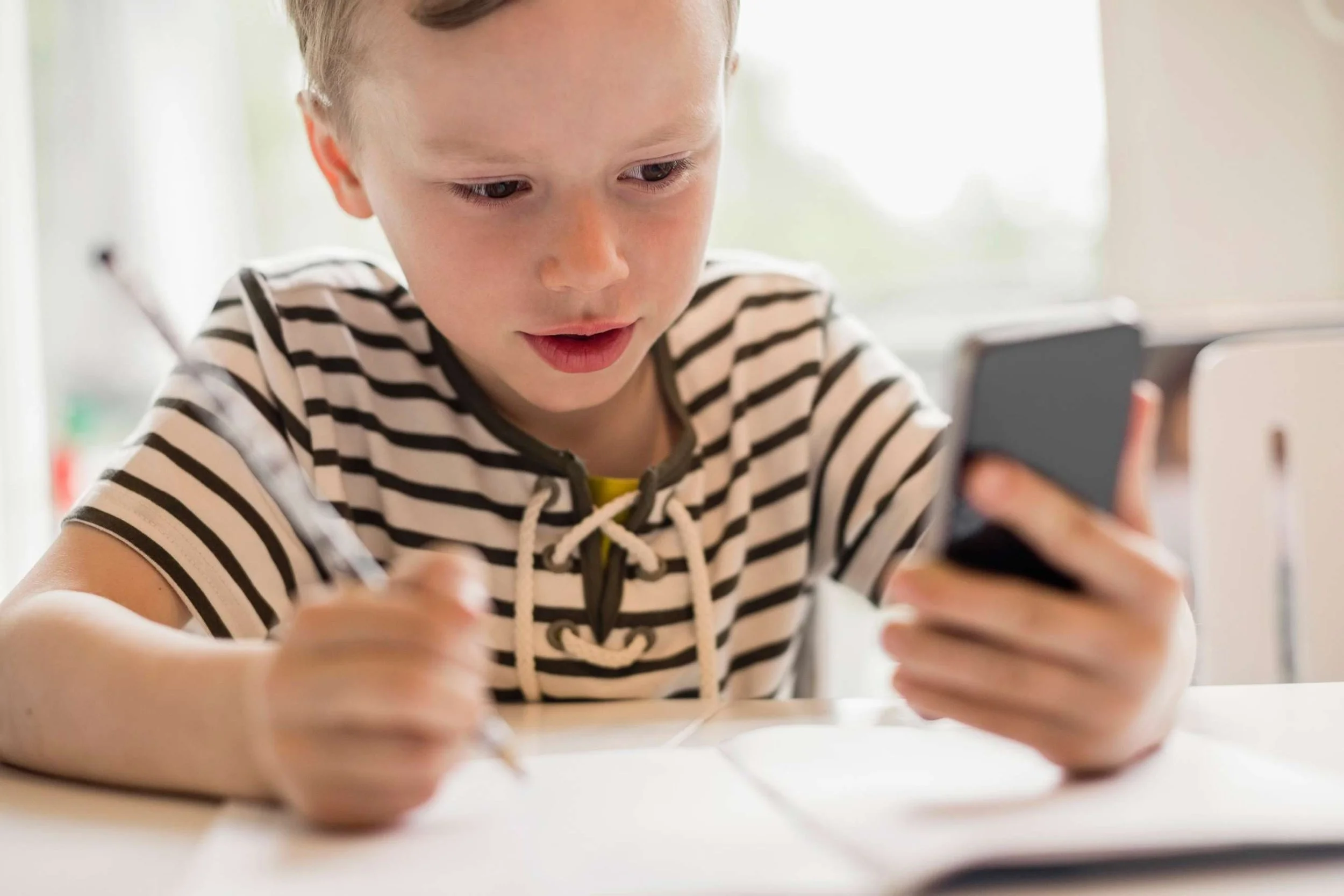
This isn’t about nostalgia or wishing modern childhood looked more like our own. And it’s not only about technology.
It’s about how the brain works and something families need to be mindful of, even if avoiding screens entirely isn’t realistic. Technology is one part of the picture, but so is something we see just as often, days filled with a constant loop of activities that leave little room for unstructured time.
Neuroscience is increasingly clear. Constant stimulation trains the brain to expect fast rewards. When that happens, slower experiences like being in the classroom, reading, building, problem-solving, or even thinking can start to feel frustrating.
Not because children lack ability. Because their brains are being trained to expect something different.
And that’s why one of the most common phrases adults hear, “I’m bored,” actually matters more than we think.
-
When children move constantly from one activity, screen, or stimulation to the next, their brains stay in a reactive mode. Something is always demanding attention.
When stimulation drops, the brain shifts into what neuroscientists call the Default Mode Network, a system linked to reflection, creativity, and long-term thinking. These “idle” moments are when important cognitive work happens.
And here’s what most people don’t realize: downtime is also how children learn to regulate their emotions.
When children experience small moments of boredom or restlessness, they learn to tolerate mild discomfort. That skill is foundational to managing frustration, regulating emotions, and building resilience.
These quieter moments allow the brain and body to reset. Attention steadies. Stress lowers.
In practical terms, when a child is staring out the window, wandering outside, or tinkering with random materials, the brain is not shutting down.
It is doing important developmental work.
-
Dopamine is the brain’s reward chemical. It drives curiosity, motivation, and learning.
Many modern experiences such as short-form video, gaming reward loops, and endless scrolling deliver dopamine in rapid, repeated bursts.
The brain adapts.
Over time, its baseline for stimulation rises. When that happens, ordinary activities like reading, building, or working through a challenging idea can start to feel slow or frustrating.
Not because the child lacks ability.
Because the brain has become accustomed to a different speed.Researchers studying attention and digital media are increasingly finding that constant novelty raises this baseline. Psychologist Jonathan Haidt and others point to this shift as one factor affecting attention, anxiety, and resilience.
This helps explain a pattern many teachers are seeing. Students capable of deep thinking can struggle when things slow down.
Their brains are simply calibrated for constant stimulation.
-
When children say they are bored, adults often rush to fix it.
We have them in baseball, dance, violin, and a well-intentioned constant loop of activity.
But boredom is often a transition, not a problem.
If it lasts long enough, the brain begins generating its own stimulation. Ideas emerge. Games take shape. Stories form.
The cardboard box becomes a spaceship.
A pile of sticks becomes an entire world.Psychologists have long observed that boredom often comes right before creativity. Without that pause, the brain never has to invent something new.
This is one of several reasons experts, along with our experience as school leaders, consistently caution against elementary-aged children having devices in their rooms.
It can quietly short-circuit these moments, replacing them with constant stimulation, limiting independent thinking, and introducing more mature issues years earlier than many parents anticipate.
We’ve seen the long-term impact of that pattern more often than families expect.
-
At school, boredom is often misunderstood.
It doesn’t always mean work is too easy.
And it doesn’t always mean a child isn’t being challenged.In fact, children will sometimes come home saying they were bored even when they are working through rich, challenging material.
What they are often experiencing is the shift from fast stimulation to sustained thinking.
Reading closely. Writing with intention. Solving a multi-step problem. Sitting with a difficult idea.
These are slower, more demanding cognitive tasks. They require effort, patience, and persistence.
For a brain used to constant stimulation, that shift can feel uncomfortable.
That discomfort often gets labeled as boredom.
At WHPS, families intentionally choose an environment with individualized challenge. Students are regularly working at the edge of their ability.
That kind of learning does not always feel exciting in the moment.
But it is where real growth happens.
⏳ What This Means for Families
This is not about eliminating technology. That’s neither realistic nor the goal.
Technology is part of modern life, and it can be incredibly useful. But children’s brains still need something that is becoming increasingly rare: unstructured time.
A few unscheduled afternoons. Device-free moments after school. Time for boredom to last long enough for creativity to emerge. Children do not need every moment optimized.
In a world designed to capture their attention, stillness may be one of the most powerful developmental tools we can give them.
Sometimes it begins with a simple phrase: “I’m bored.”
